
A company holding UAH 20 million in temporarily free funds on a deposit at 13% instead of government bonds (OVDPs) at 16.5% loses out on approximately UAH 700 thousand per year. Managing a company's free liquidity is not only about the safety of funds — it's also about how much they earn while they "wait."
Tip 1. Divide Funds by Time Horizon
The main mistake is keeping all free funds in a single instrument. A better approach is to divide them into three parts depending on when they may be needed:
Operational part (15–25%): a current account covering 1–2 months of expenses — salaries, taxes, and payments to suppliers.
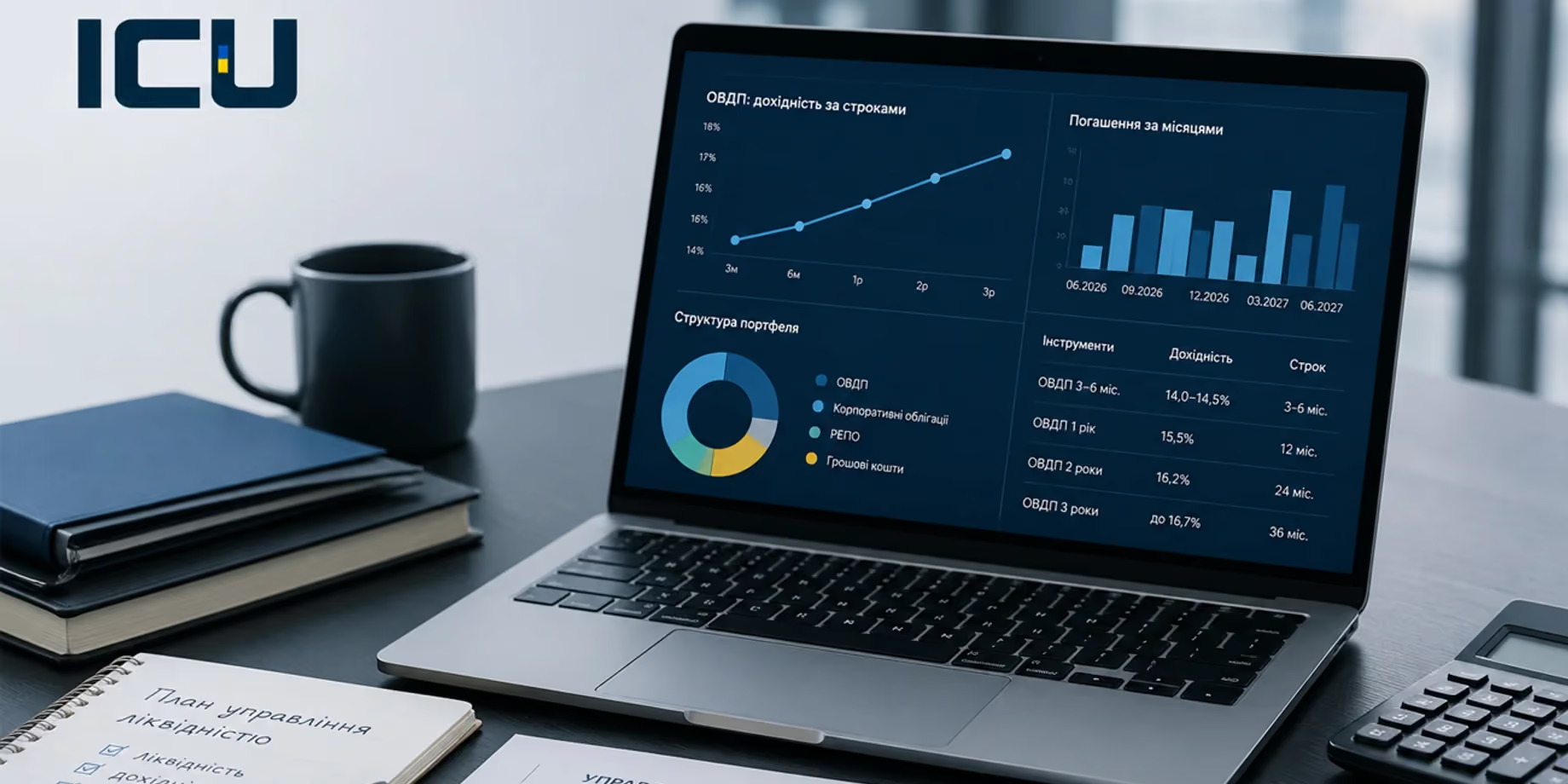
Buffer part (30–40%): short-term OVDPs with maturities of 3–6 months and an average effective yield of 14–14.5% per annum. If needed, these securities can be sold on the secondary market.
Strategic part (35–55%): OVDPs with maturities of one to three years. As of mid-2026, the effective yield at primary auctions of the Ministry of Finance of Ukraine stands at 15.5–16.85% per annum, while the secondary market offers a wide selection of issues with similar yield levels.
OVDPs carry a state guarantee, and the instrument itself is actively used by banks to place funds raised through deposits. This allows companies to earn higher returns compared to deposits by investing in a state-guaranteed instrument.
Tip 2. Build a Maturity Ladder
Investing all funds into a single maturity means depending on a single exit point. If rates rise, you won't be able to reinvest at a better price; if you need the money, you'll have to sell the entire portfolio.
A "maturity ladder" solves both problems. For example: 30% in OVDPs maturing in 3 months, 30% in 6–9 months, and 40% in 12–18 months. Every 3 months, a portion of the funds is automatically released for reinvestment or operational needs, while the rest continues to work at higher rates.
For portfolio diversification, companies may also consider corporate bonds. Depending on the issuer, their yields currently start at around 18% and can reach 22–24% for one-year issues. However, selecting such instruments requires thorough issuer analysis, so it is important to rely on professional market expertise.
Tip 3. Use Repo Instead of Early Exit
If a company needs to raise liquidity quickly, a repo transaction allows it to use OVDPs as collateral to obtain financing for an agreed term without having to sell the securities.
At the same time, repo can also be used in the opposite direction — for short-term placement of temporarily free funds without being tied to the OVDP maturity date. In this case, the company temporarily places funds secured by government bonds for a defined term (usually from two weeks to one month), with the option to extend the transaction and revise its parameters.
This is why OVDPs are not only an investment instrument but also an effective tool for managing corporate liquidity.
Why Businesses Choose ICU
Among those who choose ICU are many companies looking not just for a broker, but for a partner with expertise in corporate liquidity management. ICU has been operating in the Ukrainian market since 2006 and holds one of the largest proprietary and client OVDP portfolios, along with many years of experience working with government securities.
This enables the company to offer competitive investment terms even for large volumes of funds — starting from tens of millions of hryvnias. If a business plans to invest more than UAH 200 million, ICU can arrange the client's participation in primary auctions of the Ministry of Finance of Ukraine. For other volumes, a wide selection of OVDP issues is available on the secondary market.
In addition to OVDP transactions, corporate clients can use repo operations, receive analytical support, and get advice on building a diversified portfolio that may include both government and corporate bonds — aligned with the company's payment calendar, financial policy, and investment objectives.